



 Plastic Sheet
 Food Containers
 Sealing Film


How to Select Plastic Sheets for Thermoformed Food Packaging

Sheet selection determines how a thermoformed package performs, whether it meets food-safety rules, and what it costs. Three criteria should guide every decision: application requirements, regulatory compliance, and cost.
Material properties drive the choice. Barrier performance, clarity, rigidity, temperature resistance, and chemical compatibility all matter. Thermoformed plastic packaging typically costs between $0.10 and $1.30 per unit, so budget shapes the shortlist too. Choosing well protects product integrity and avoids supply chain failures.
This article compares common food-grade plastics for food packaging and gives a step-by-step process for selecting the right sheet. Readers can apply that process immediately to select plastic sheets for their production line.
Key Takeaways
Choose a plastic sheet that fits your food's needs, like heat resistance or barrier protection.
Always check for food-safety compliance and ask for written proof from suppliers.
Compare total costs, including scrap and cycle time, not just the sheet price.
Test your chosen sheet on the actual tool before starting full production.
Balance performance, safety, sustainability, and cost to protect your food and your budget.
How to Select Plastic Sheets: Materials Overview
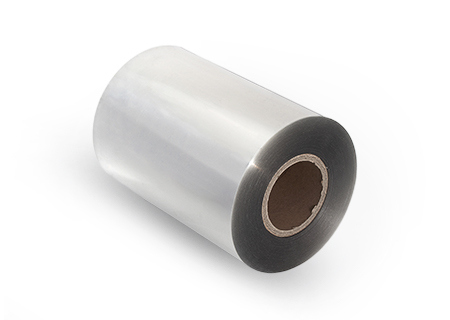
Sheets arrive as rollstock or cut sheets. An oven heats each sheet before vacuum or pressure forming shapes it. The starting material sets formability, protection, and cost.
Common Food-Grade Plastics
Common food-grade plastics fall into a few families:
PET and PETG plastics deliver clarity and recyclability. PET plastic serves cold and ambient displays.
PP resists heat and suits microwave containers.
HIPS forms rigid trays at low cost.
HDPE adds toughness and moisture resistance.
PS, PVC, OPS, and LDPE cover low-cost and specialty roles.
Barrier properties describe how well a sheet blocks moisture vapor, liquid water, oil, and grease. Glass transition temperature (Tg) marks where a polymer shifts from glassy to rubber-like, directly impacting formability and barrier performance at different processing temperatures.
Material | Key properties and applications |
|---|---|
PP | Heat resistance; microwave trays |
HIPS | Rigidity; printed trays |
HDPE | Toughness; tubs |
Ultimately, PP dominates microwave applications due to its heat tolerance, HIPS leads in cost-effective rigid display trays, and HDPE remains the standard for impact-resistant tubs.
Specialty and Multilayer Options
CPET handles dual-oven use. EVOH and high-barrier coatings build oxygen barriers into multilayer structures, while GAG provides an excellent balance of clarity, printability, and cost for standard trays. PLA and CPLA offer compostable paths, and rPET (recycled PET) supports sustainability goals. These food-grade thermoforming plastics extend performance where one layer falls short.
Thermoforming Process Basics
Formability Factors
The thermoforming process heats a plastic sheet and stretches it against a mold. Formability decides whether the finished part holds its shape, wall thickness, and strength.
Melt viscosity, elasticity, and temperature sensitivity set the processing window. Sheets with broader temperature ranges reach higher draw ratios without losing part quality.
Strain-hardening behavior resists localized thinning. Strong strain-hardening supports deeper parts with more uniform wall thickness.
Hot strength and elongation at break set the practical draw ratio limit. The sheet needs enough strength to resist tearing and enough stretch to fill complex geometry.
Draw ratio compares final formed depth to initial sheet dimensions. Excessive draw ratios thin high-strain regions and raise rejection rates. Jamestown Plastics notes that deep draws, sharp corners, and steep walls thin material quickly. Controlled draw ratios, strategic ribbing, and plug-assisted forming distribute the sheet more evenly. Zone-controlled heating and infrared sensors keep temperatures uniform, which supports consistent draw ratios. Better distribution cuts scrap and improves repeatability across production runs.
Thickness and Clarity Trade-Offs
Sheet thickness shapes durability and appearance at the same time. Thicker sections add stiffness and seal strength. Thinner, well-formed sections of PETG or CPET tend to stay clearer. Clear walls display the product and support shelf appeal.
This trade-off affects packaging design decisions. A thicker sheet improves rigidity and seal performance. A thinner sheet saves material and often looks brighter. Ease of thermoforming also shifts with thickness, because heavy sheets need more heat to reach the forming window. Designers should match thickness to the part's load and display needs. A short trial run on the actual tool reveals thinning patterns that flat samples cannot show.
Matching Food-Grade Thermoforming Plastic to Needs
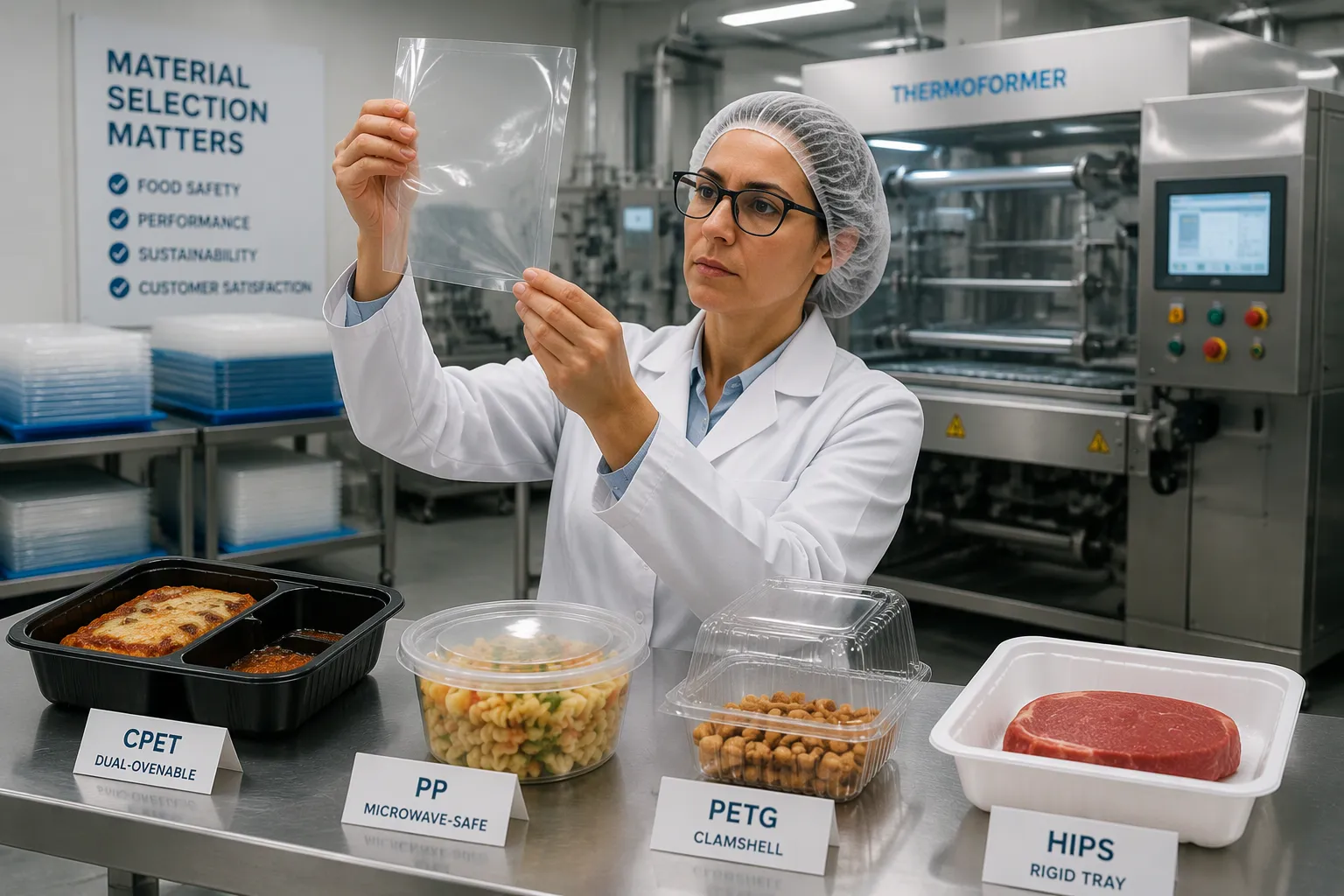
The shortlist narrows once requirements are clear. The comprehensive matrix below maps common thermoforming options to their strongest applications and processing advantages.
Sheet Type | Best Fit / Food Applications | Key Thermoforming Advantage |
|---|---|---|
CPET | Dual-ovenable trays, hot entrees | High heat resistance (up to 220°C) |
PP | Microwave meals, hot-fill sauces, yogurt | Excellent moisture barrier, microwave-safe |
PETG / rPET | Clarity, chilled ready meals, bakery | High impact strength, great display clarity |
HIPS | Dry snacks, printed lids, egg cartons | Cost-effective, easy to thermoform |
HDPE | Frozen foods, deli tubs, ice cream | Toughness, low-temperature impact resistance |
EVOH / GAG | Fresh meat, cheese, high-barrier needs | Extended shelf life, oxygen protection |
PLA / CPLA | Compostable serviceware, cold cups | Eco-friendly, biodegradable options |
Barrier and Temperature Requirements
Oxygen and moisture barrier decide shelf life for sensitive foods. PET shows low permeability and high stability, according to Society of Plastics Engineers (SPE) guidelines. PP withstands temperatures up to 121°C, making it ideal for microwave use. CPET handles extreme heat up to 220°C for dual-oven applications. While PVDC creates an outstanding oxygen and moisture barrier, its chlorine content poses recycling challenges, leading many major global brands to phase it out in favor of EVOH or mono-material recyclable structures. Nylon (PA) offers a high melting point and excellent puncture resistance.
Sheet | Heat limit | Barrier note |
|---|---|---|
PP | 121°C | Moderate moisture barrier |
CPET | 220°C | Excellent heat and moisture barrier for dual ovens |
EVOH (Co-extruded) | Varies by host layer | Outstanding oxygen barrier |
PVDC | Heat resistant | Outstanding barrier, but facing phase-outs due to recycling challenges |
Nylon (PA) | High melting point | Good oxygen barrier and puncture resistance |
Barrier needs vary by product. A dry snack tolerates a simple sheet. A fresh cut of meat does not. A hot-fill line needs a sheet that holds shape near boiling, and a frozen line needs moisture control more than heat tolerance.
Product Compatibility and Shelf Life
Chemical resistance describes a material's ability to withstand chemical attack without significant loss of performance. Weak compatibility produces cracking, swelling, softening, and shortened service life. Heat accelerates chemical attack, and resistance generally falls as temperature, concentration, and exposure time rise. Fatty sauces, acidic dressings, and hot entrees test a sheet hardest. Dairy and fresh meat reward a tight oxygen barrier.
A hot-fill line favors PP. A frozen line favors HDPE. A dry-goods line favors HIPS. Each choice balances durability, temperature resistance, chemical stability, and cost. Buyers should confirm food-safe plastic status and check that food-grade plastics meet the target market's rules. The right material protects the food inside, and packaging performance follows from it.
Food-Contact Compliance
FDA and EU Framework Basics
Food-contact rules protect consumers in every major market. The European Commission states that all packaging materials intended to come into contact with food must comply with strict EU safety rules (such as Regulation (EU) No 10/2011). These rules ensure that packaging does not release substances into food that could endanger health. The EU Plastics Regulation adds a positive list of permitted substances and sets an overall migration limit.
The United States regulates food-contact substances through Title 21 of the Code of Federal Regulations. The FDA maintains an Inventory of Effective Food Contact Substance Notifications. A sheet intended for direct food contact must rest on an authorized substance. Compliance is a shared duty between the converter, the sheet supplier, and the brand owner.
Documentation and Verification
Buyers should request written proof before placing an order. A Declaration of Compliance confirms that a material meets the relevant regulations. The document should name the food types, temperature conditions, and contact duration the sheet is rated for. A generic "food safe" claim without third-party proof is a warning sign.
Third-party test reports add independent weight. Reputable labs include SGS, Intertek, Bureau Veritas, and Eurofins. Reports should show migration results and the lab's ISO 17025 accreditation. At Huisu, we provide full Declarations of Compliance, ISO 9001 traceability, and third-party SGS/Intertek migration test reports with every batch of our food-grade CPET and PP rollstock to ensure your packaging line never stops. Verification steps are simple: check certificate numbers, confirm lab accreditation, and search the supplier name against FDA warning letters.
Cost Considerations
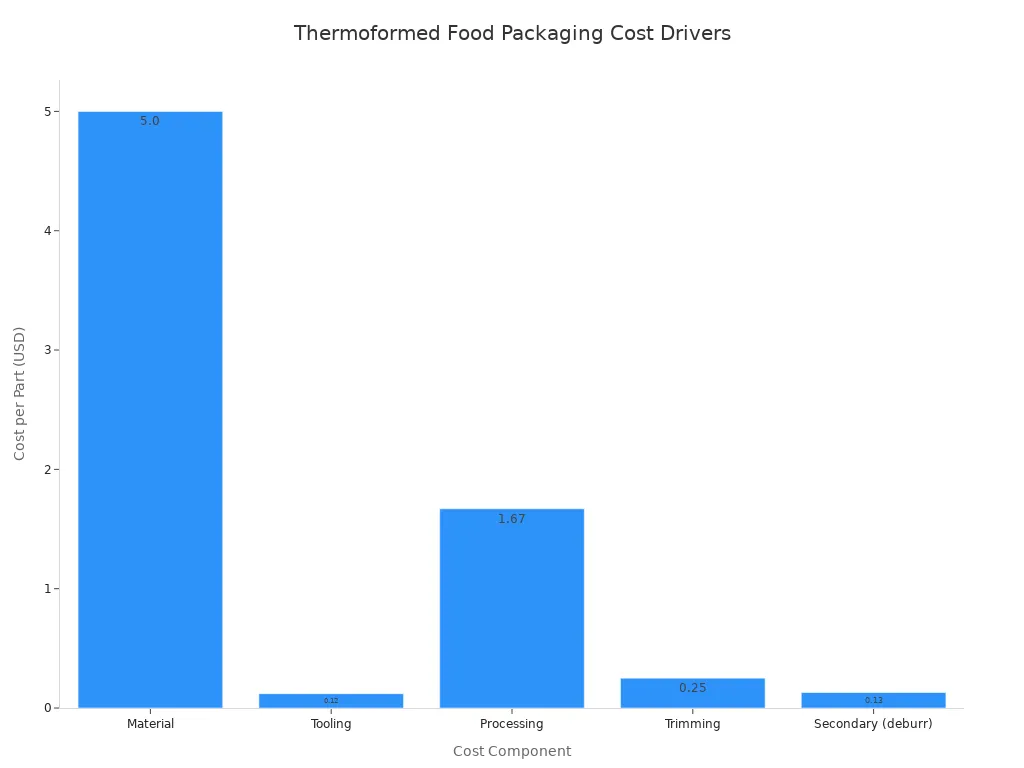
Material and Processing Cost Drivers
Sheet price is only one line in the cost structure. Scrap is the hidden driver. DFMA reports typical scrap rates of 20-50%, because web between parts and trim perimeter loss leave only 50-80% of raw sheet in the final part. Effective material cost therefore runs 25-50% higher than the nominal sheet price.
Processing cost follows cycle time multiplied by machine rate. General cycle times run 15-120 seconds, with heating and cooling as the rate-limiting steps. Thickness shifts the machine class: in-line machines handle thinner gauges, and shuttle machines handle thicker sheets. The cost and ease of forming therefore move together.
Cost Driver | Industry Standard Data |
|---|---|
Typical scrap rate | 20-50% |
In-line cycle time | 15-30 seconds |
Shuttle cycle time | 60-120 seconds |
HIPS material cost | $1.00-$1.50/lb |
PETG material cost | $2.00-$4.00/lb |
Balancing Performance and Budget
Unit price alone misleads. Total cost of ownership requires weighing raw material sourcing, manufacturing, transportation, usage, and end-of-life disposal together. Shelf life belongs in that math, because spoilage losses can outweigh a small sheet saving. The cheapest film rarely represents the lowest total cost.
Sustainability costs also belong in the figure, as brands increasingly demand PCR (Post-Consumer Recycled) content or mono-material structures to meet corporate ESG goals and new packaging regulations. A sheet that runs poorly costs more than a slightly pricier sheet that runs clean. The right materials balance performance, compliance, and cost for the specific application.
Material Selection: Step-by-Step Guide
Define Requirements and Shortlist
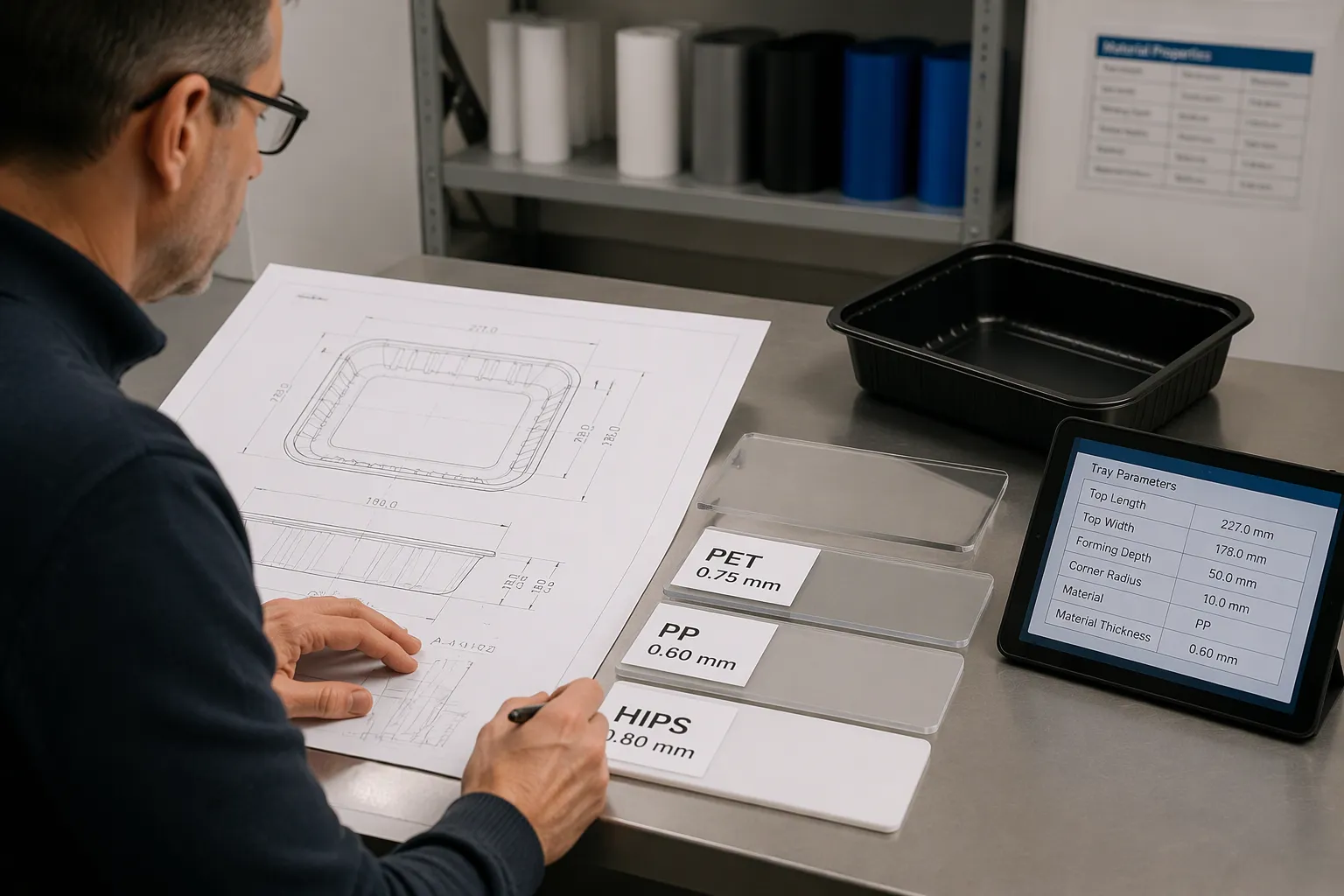
A clear requirement list shortens the shortlist. Start with the tray's top dimensions, bottom dimensions, and forming depth. Then confirm the material, sheet thickness, cavity layout, and required output. A dimensioned drawing or physical sample makes the first technical review far more accurate.
Tray Parameter | Why It Matters |
|---|---|
Top length and width | Defines product and mold dimensions |
Bottom dimensions | Shows wall taper and lower cavity geometry |
Forming depth | Affects material stretch and forming requirements |
Flange or rim | Affects sealing, lid compatibility, and trimming |
Plastic material | Determines heating and forming behavior |
Sheet thickness | Affects forming behavior, product weight, and material consumption |
Roll specs differ by material. PET is produced in roughly 0.18–1.7 mm thickness and 250–1400 mm width. PP runs 0.3–2 mm and 300–900 mm, and HIPS runs 0.24–2 mm and 300–900 mm. Teams that select plastic sheets against these ranges avoid ordering a gauge the supplier cannot run.
Validate, Test, and Finalize
Shortlisted sheets now face proof. Follow this sequence:
Confirm food-contact compliance. Request a Declaration of Compliance that names the food types, temperatures, and contact times the sheet is rated for.
Compare total cost. Weigh material, scrap, cycle time, and tooling together, not unit price alone.
Prototype on the actual tool. A short run reveals thinning, seal quality, and trim behavior that flat samples hide.
Test the finished tray in its packaging system. Define whether the tray meets film sealing, overwrap, or a separate lid, because the rim and flange must match the downstream process.
Material selection ends when the trial tray passes every check. Careful thermoforming trials confirm both safety and performance.
A sound selection sequence moves from requirements to properties, then to compliance, then to cost. Prototype shortlisted sheets on the actual tool before committing to production to reduce risk and avoid costly surprises.
Need Help Selecting the Right Thermoforming Sheet?
Don't risk production delays or compliance failures. Contact the packaging engineers at Huisu today for a free material consultation, custom gauge recommendations, and FDA/EU compliant sample testing.
Get a Quick Quote & Free SamplesFAQ
Which sheet works best for a dual-ovenable tray?
CPET is the standard choice for trays that go from freezer to oven. It holds shape at high heat (up to 220°C) and resists moisture. PP suits microwave-only use, so it fits a narrower temperature range. Match the sheet to the actual reheating method before finalizing the design.
How do I confirm a sheet is safe for direct food contact?
Request a Declaration of Compliance from the supplier. The document should name the food types, temperatures, and contact times the sheet is rated for. Ask for third-party migration test reports from an accredited lab like SGS or Intertek.
Does a higher barrier always mean a better package?
No. Barrier needs follow the product. Dry snacks tolerate a simple sheet, while fresh meat and cheese reward a tight oxygen barrier. EVOH builds high-barrier structures for sensitive foods. Over-specifying barrier adds cost without adding shelf life.
Why does unit price mislead on packaging cost?
Scrap, cycle time, and tooling often outweigh the sheet price. Thermoforming scrap rates can reach 20-50%, so effective material cost runs well above the nominal figure. A slightly pricier sheet that runs clean can cost less per finished part.
Should I test before committing to production?
Yes. A short trial run on the actual tool reveals thinning, seal quality, and trim behavior that flat samples hide. Test the finished tray in its full packaging system, including film sealing or lid fit. Prototyping reduces risk before full production begins.
Stay Connected with HSQY
Recommended Products
Super Clear 150 200 250 350 Micron Printable Pet Sheet Rolls for Plastic Coffee Bubble Tea Cup
Factory Price 300 Micron Pet Sheet Rigid Clear Pet Film

0.25mm 0.30mm Clear PET Rigid Sheet PET Film for Vacuum forming
Transparent Clear Plastic PET/PE Laminated Film For Plastic Food Tray
High-quality PET/PE Laminated for Thermoforming And Food Packaging