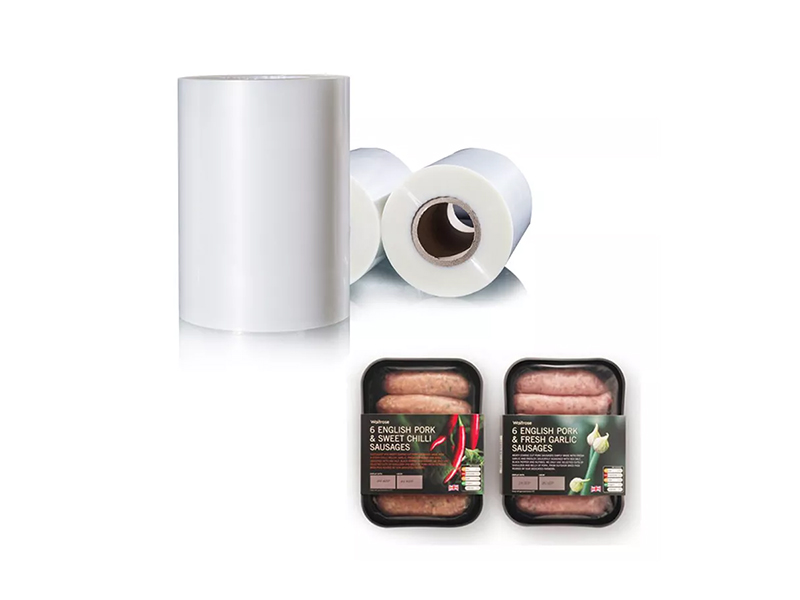



 Plastic Sheet
 Food Containers
 Sealing Film
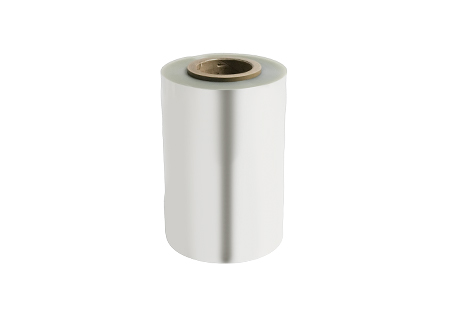


Parafilm vs Polyolefin Sealing Films for Lab Use
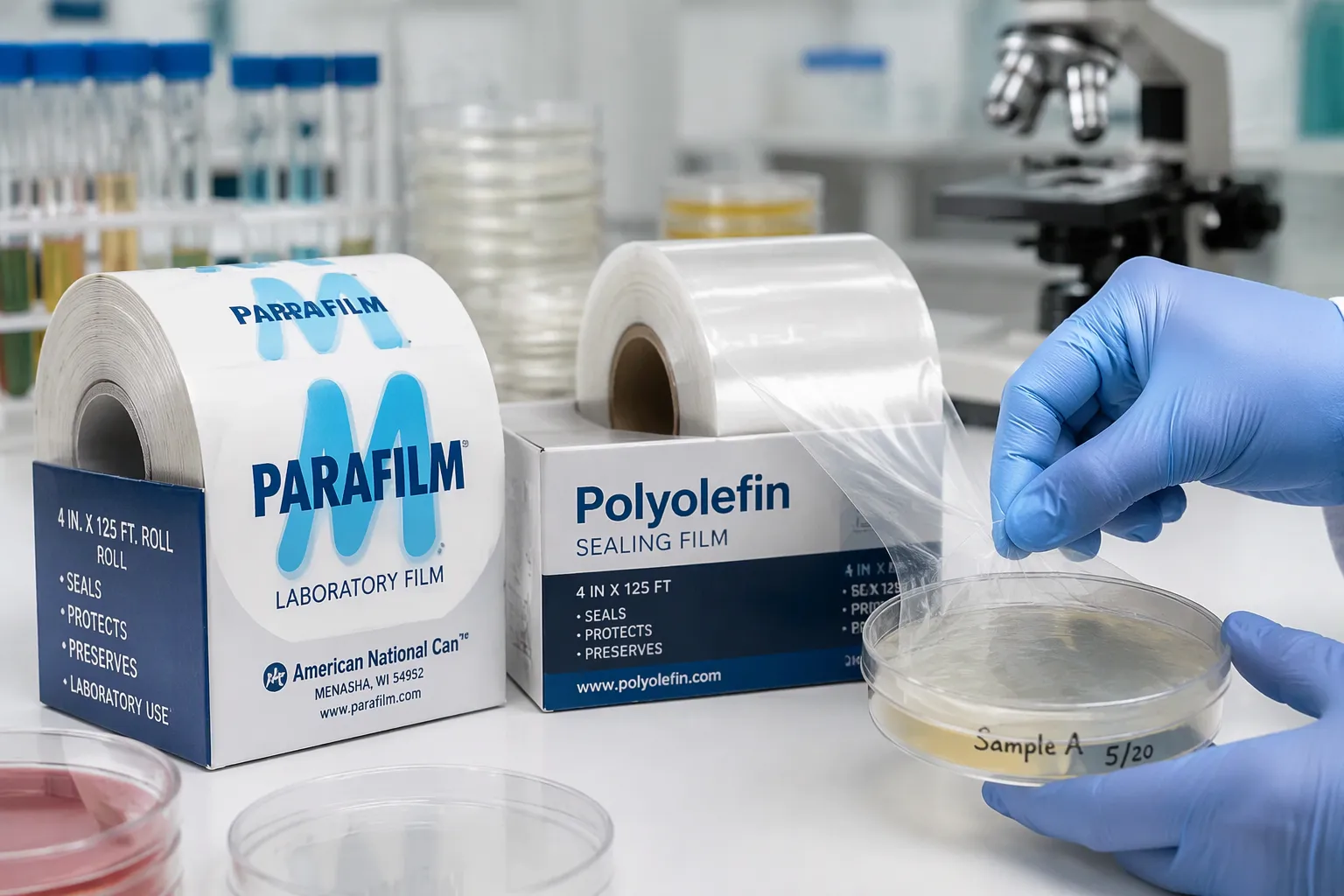
Short answer: if you seal microplates, PCR plates, or any flat rim at volume, polyolefin film is the better default. If you wrap flasks, Petri dishes, or vessels with irregular rims, Parafilm still does the job with less fuss. Four variables decide it: vessel geometry, temperature and hold time, sterility requirements, and cost per successful seal.
This guide works through all four, then gives you a protocol you can run on your own bench before committing to a case. Scope: flasks, beakers, tubes, Petri dishes, 96- and 384-well microplates, and PCR plates. It does not cover heat-seal packaging film or gas-permeable culture membranes, which are separate categories with separate selection criteria.
Key Takeaways
Match the film to the vessel: flat rims and plates favor polyolefin, irregular rims and dish wrapping favor Parafilm.
Parafilm cannot be autoclaved. If your protocol sterilizes after sealing, you need polyolefin.
Test films side by side in your lab before committing to a case.
Judge cost by cost per successful seal, not price per roll.
Confirm sterility grade, nuclease status, and lot documentation before you buy in full.
Application Comes First: Matching the Film to the Vessel
Match the Film to Workflow Conditions
Picking a film starts with the task, not the catalog. Four things shape the decision: vessel type, temperature, duration, and surface condition. A round flask, a round agar plate, and a screw-cap tube each need a different wrap. A short room-temperature hold is not the same as an overnight incubation or a cold-storage run. Smooth glass takes a seal differently than a textured or damp surface.
List those conditions before comparing products. The list turns a vague preference into a testable requirement, and it shows where a seal has to hold under stress. A film that suits one workflow can fail another for reasons unrelated to quality.
Where Each Film Fits Best
Parafilm offers two-way stretch and a semi-transparent, malleable character. Those traits suit wrapping and sealing agar plates and irregular vessels. The film conforms around curves and corners, and it holds where a rigid sheet would lift. Technicians reach for it when the vessel shape resists a flat seal.
Polyolefin sealing film stretches evenly in the machine direction. That behavior gives tighter, more controlled seals on uniform containers, because tension spreads across the rim instead of pooling at a few points. Labs that seal many identical vessels tend to prefer the predictability.
The split is practical rather than ideological: Parafilm for irregular shapes and dish wrapping, polyolefin for uniform vessels that reward controlled tension. A laboratory that runs both tasks should stock both films instead of forcing one to cover the other.
Flat Rims and Multi-Well Plates
Polyolefin wins on flat, uniform rims, and nowhere more clearly than on microplates. A 96- or 384-well plate presents up to 384 small openings across a rigid flat surface. Parafilm has to bridge each well individually. Stretch it across the plate and the tension concentrates in the thin webs between wells; as the film relaxes, that stored tension pulls it back. The result is edge lift and cross-well wicking that appears an hour into a run, not at application.
A polyolefin seal is applied as one sheet across the whole plate, by hand or with a plate sealer, so tension distributes across the plate rather than across individual wells. For qPCR, fluorescence imaging, and any protocol where cross-contamination between wells is unacceptable, this is not a matter of preference.
Three specifications matter when you choose a plate seal. Optical clarity: for fluorescence or absorbance reads, use an optical-grade seal and confirm compatibility with your instrument's read height. Nuclease status: RNA and low-copy work needs a seal certified RNase- and DNase-free, usually gamma-irradiated. Peel behavior: the mechanics are the same as in any peelable lidding film, and a seal that tears or leaves adhesive on the rim contaminates the next plate in a stack.
Parafilm still has a place on plates: sealing a plate you are carrying down the corridor, or covering one that will be read within the hour. It is not the right choice for a run that sits overnight.
Application | Temp. | Hold time | Sterile | Recommended | Why |
|---|---|---|---|---|---|
96-well PCR plate | 4–25 °C | < 24 h | Yes | Polyolefin | Flat surface, single-sheet seal |
384-well plate, fluorescence | 25 °C | < 4 h | Optional | Polyolefin, optical grade | Low autofluorescence, no residue |
Erlenmeyer flask, shaking culture | 37 °C | 3–7 d | Yes | Polyolefin, vented option | Edge lift risk at high humidity |
Test tubes, short-term storage | 4 °C | < 48 h | No | Parafilm | Conforms to curved rims |
Deep-well plate, archive | −80 °C | > 1 month | Yes | Polyolefin | Adhesion retained at low temperature |
Round-bottom flask, solvent work | 25 °C | < 8 h | No | Polyolefin, solvent-resistant grade | Parafilm dissolves in many organics |
Technical Performance: Parafilm vs Polyolefin
Stretchability, Clarity, and Handling
Parafilm is a blend, not a single material: a wax-dominant compound with a polyolefin fraction, on a formulation that has barely changed since the 1930s. That matters for this comparison. The question is not wax versus plastic, but a wax-dominant blend, which behaves like a soft self-fusing film, against a single-material polyolefin sheet, which behaves like a tensioned membrane.
The wax fraction gives Parafilm its self-sealing behavior and its water-vapor barrier; the polyolefin fraction gives it stretch. Manufacturer data puts the elongation at up to 200 percent, which is why the film can be pulled around a curve without tearing and will hold a tight, moisture-resistant seal over test tubes, beakers, flasks, and Petri dishes.
Handling complaints center on the same design. The backing paper sometimes sticks or tears the film, a roll left too long in a warm drawer can go stale or pick up pinholes, and cutting strips by hand adds time to every task. Polyolefin seals skip the backing paper and the strip cutting, so application is a single pull-and-press motion.
Protecting Samples From Contamination
Protecting samples depends on one property: a continuous, well-adhered barrier. A gap, a lifted edge, or a pinhole breaks that barrier, and airborne particles or stray droplets reach the sample. A clear sealing film helps here, because a technician can check the seal without removing it.
Parafilm's self-sealing behavior comes from its wax content. Two layers pressed together fuse into one sheet, so the wrap closes over itself, which is what makes it work on the neck of a flask or any irregular opening.
Polyolefin film holds by adhesion and controlled tension rather than fusion. Applied correctly, both approaches reduce contamination risk; the difference shows up in the workflow rather than in the chemistry alone. A seal that stays adhered through the full task protects the sample. One that lifts early does not, whatever its stretch rating says.
Preventing Evaporation and Managing Chemical Resistance
Moisture Barriers and Seal Durability
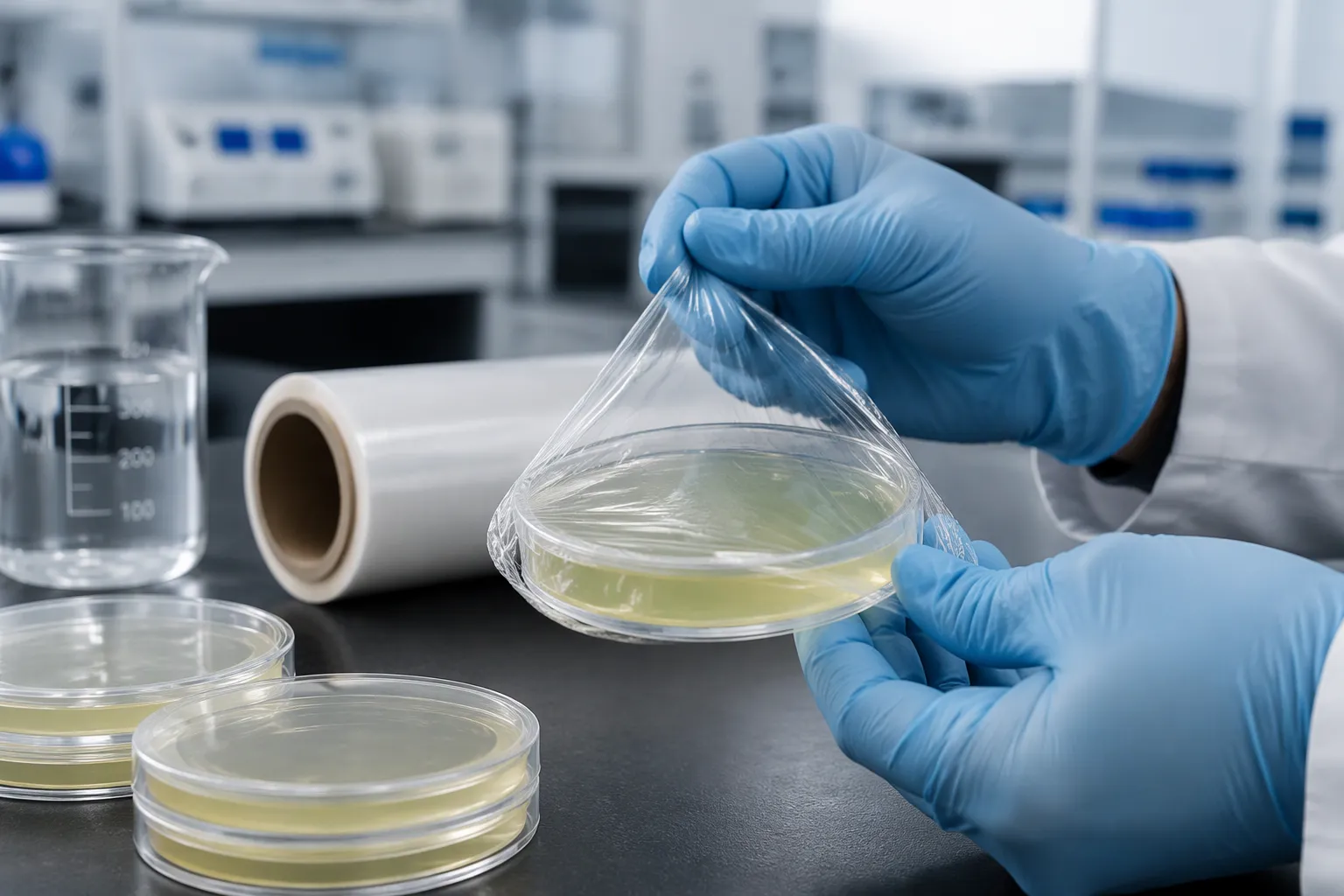
Stopping evaporation requires a seal with no breaks and good adhesion to the container. A lifted edge or a pinhole lets vapor out, and the sample volume drops over time. How long the seal lasts matters as much as the first stick: a wrap that holds at hour one but lifts at hour twelve fails the job.
Parafilm's wax-based makeup handles this well, which is why labs use it to keep moisture inside agar plates. The same datasheets state its limit plainly: it resists saline solutions, inorganic acids, and alkaline solutions for up to 48 hours, and it is soluble in many organic solvents. Chloroform, toluene, and similar non-polar solvents will dissolve it.
Barrier figures in this category are easy to misread. Amcor, which manufactures Parafilm M, publishes an internal comparison in which competitor laboratory films showed 680% higher water-vapor and 800% higher oxygen transmission rates than Parafilm M. Read that for what it is: a manufacturer's test of its own product, on films of unspecified thickness and grade. It is a starting point, not a neutral benchmark.
What it does establish is that transmission rate is a specification, not a category property. A 50 µm polyolefin film and a 100 µm one are different products with different WVTR, and construction matters as much as gauge: a mono-layer sheet and a multilayer co-extruded barrier film of the same thickness will not transmit at the same rate. Ask for the WVTR and OTR of the exact grade you are quoting, at the thickness you will actually buy, tested to ASTM E96 or F1249, then compare that number against your hold time. A 24-hour assay and a six-month archive do not need the same barrier, and many labs over-specify because nobody measured what the work requires.
One related point, because it causes real errors: standard polyolefin sealing film is a low-permeability barrier, not a gas-exchange membrane. If your culture needs CO2 exchange, you want a vented or gas-permeable culture membrane, which is a different product with a different specification.
Solvent and Temperature Considerations
Chemical resistance changes by film and by solvent class. A film that handles aqueous solutions well may soften under an organic solvent, and temperature adds another variable. A seal that holds at room temperature may fail in a cold room or a warm incubator, so compatibility has to be checked per solvent and per temperature range before a full order.
The Amcor figures are a useful starting point but a narrow one: isopropanol and ethanol transmission differed little between the films, while heptane differed by 35 percent. A lab working with alcohols faces a different risk from one handling non-polar solvents, and no single rating covers all conditions.
Temperature is where the two films diverge most sharply, and where the most common question has a one-word answer. Parafilm cannot be autoclaved: it softens well below 121 °C and will melt onto the vessel. If your protocol sterilizes after sealing, use a polyolefin grade rated for it, or sterilize first and seal afterwards. Across the working range, polyolefin retains adhesion at −80 °C while Parafilm turns brittle and lifts at the edges; both work at 4 °C and at room temperature, with Parafilm easier on irregular rims; at 37 °C in a CO2 incubator, condensation under the film lifts Parafilm's edges within hours — the same mechanism that anti-fog sealing film is formulated to counter — while a pressure-sensitive polyolefin seal holds, though pooling beneath the seal still needs checking.
Practical guidance beats a broad claim. Test the film against the real solvent at the real temperature, and watch for softening, lifting, or color change over the planned hold time. A short trial protects sample integrity better than a spec sheet alone.
Supply Reliability, Sterility, and Total Cost
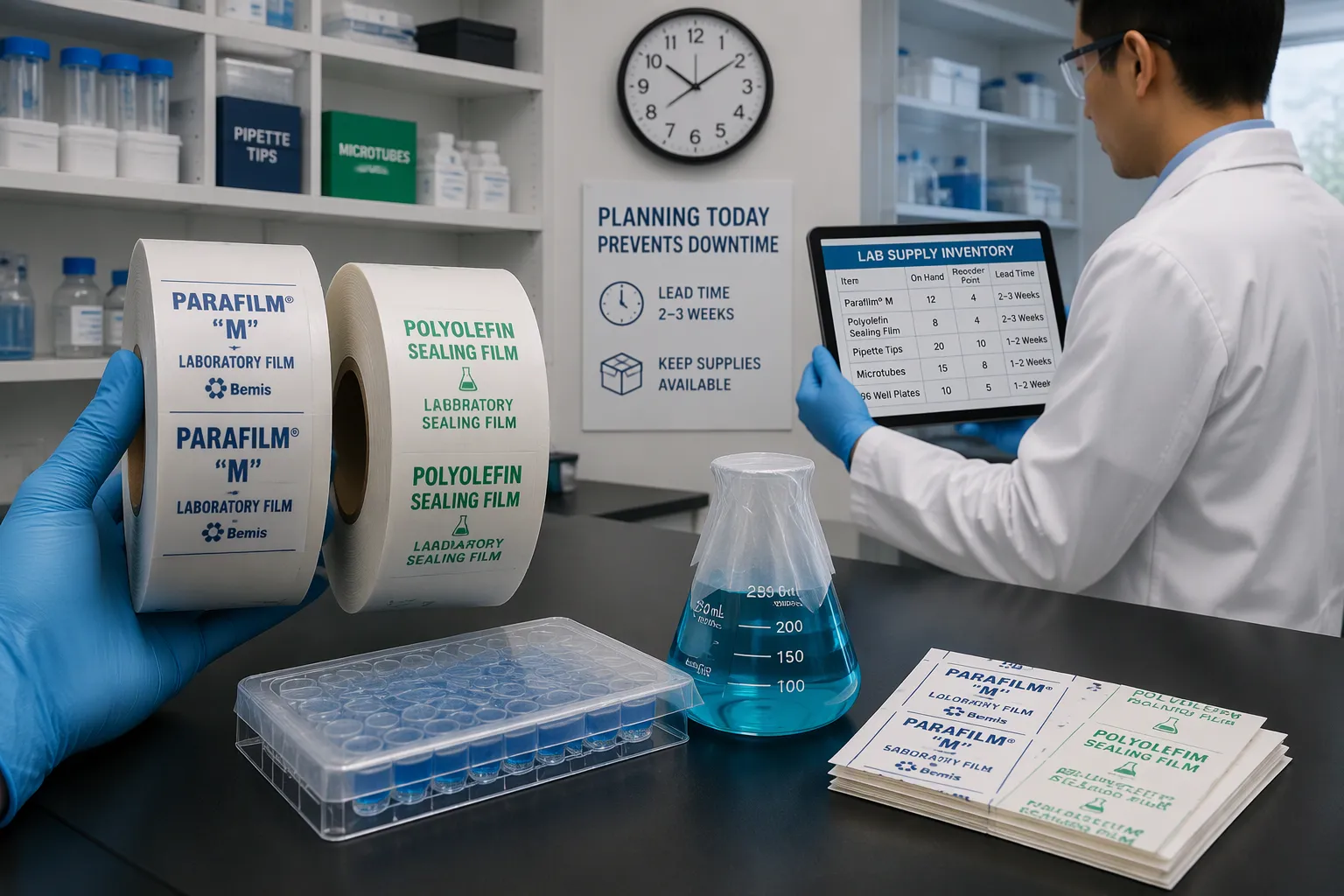
Availability, Consistency, and Lead Times
Parafilm is widely used in research settings, and it costs a lot. That price gap sends many labs looking for cheaper options, but price alone tells only part of the story. A familiar brand that vanishes when a lab needs it is an immediate risk to daily work: emergency swaps, rush shipping, split orders, and rewritten procedures all add cost that never appears on the unit price. Availability is part of the product.
Consistency counts just as much. A roll that behaves the same way every time lets technicians work without doubting the material; a batch that stretches differently or sticks to its backing paper slows every task. Scale helps here. HSQY, for example, runs more than 40 extrusion lines across 12 affiliated factories and holds ISO 9001 certification, with FDA food-contact declarations and lot-level certificates of analysis available on request. That scale is how a large supplier keeps lead times short and quality steady, but it does not settle the film comparison: both materials can be reliable when sourced well.
Sterility Grades and Documentation
Film touches your sample, so its sterility is part of its specification. Three options exist and they are not interchangeable. Non-sterile film is fine for general sealing where the sample is not at risk, but wrong for cell culture. Gamma irradiation, commonly 10 to 25 kGy, is the standard for cell culture and molecular work; ask for the dose and the sterility assurance level. Ethylene oxide is used where gamma would damage the film or its packaging, and residual levels must be declared.
For molecular work, ask for an RNase-, DNase-, and DNA-free statement. For cell work, ask for endotoxin data if the film contacts media. Then the procurement file: a certificate of analysis per lot, lot-to-lot data on thickness and adhesion, a technical data sheet with WVTR, OTR, and temperature limits, and the regulatory declarations that apply in your market. If a supplier cannot produce a CoA on request, that is your answer about lot consistency.
Cost per Successful Seal, Not per Roll
A low purchase price can mislead. Film that tears, wastes easily, or needs more material per use costs more than the sticker suggests, and the real comparison is cost per successful seal over the life of the roll.
The formula is simple: cost per successful seal = (roll price ÷ usable seals per roll) ÷ sealing success rate. A roll that costs $30 and yields 400 seals at a 92 percent success rate works out at 30 ÷ 400 ÷ 0.92, or $0.082 per successful seal. A polyolefin roll at $45 yielding 900 seals at 99 percent gives 45 ÷ 900 ÷ 0.99, or $0.051. The cheaper-looking roll is 60 percent more expensive once failure enters the calculation.
Seal failures rarely look dramatic at first. A slightly lower liquid level, a contaminated culture, a solvent smell near the bench, or a sample damaged in transit all point to the same problem. Evaporation changes concentrations, cuts the sample volume available, alters experimental conditions, and forces rework. Each failure adds hidden cost to the roll.
That is the argument for measuring rather than assuming: track how many seals each task consumes and how often a wrap fails, and the comparison stops being a matter of opinion.
Qualifying Film in Your Own Lab
A Simple Side-by-Side Test
A short trial tells you more than any spec sheet. One week, one task, two films. Pick your highest-volume workflow: one vessel type, one hold time, one temperature. Seal at least three vessels with each film, using the same operator for both, and hold them under your real conditions for the full duration.
Then measure three things. Seal integrity: look for lifted edges, gaps, and pinholes at the start and end of the test. Evaporation loss: weigh each container before and after the wait. Handling time: cover the whole motion of peeling, stretching, applying, and trimming. A film that saves a few seconds on every wrap pays off over a busy week.
Repeat once with a different vessel or solvent. Two rounds show whether the film gives repeatable results or just one lucky first try.
Scoring Results Against Priorities
Numbers alone do not pick a winner. Rank your own priorities first: seal integrity usually leads, because a failed wrap risks contamination and lost samples; availability comes next, since a film nobody can restock slows the workflow; cost per successful seal comes last, measured over the life of the roll rather than at purchase.
A simple scorecard works well. Rate each film from one to five on every priority, weight the scores by importance, and let the higher total earn the trial order. That keeps the decision tied to evidence from the bench rather than habit or brand familiarity.
If you seal microplates or PCR plates, choose polyolefin. If you wrap irregular vessels and dishes, keep Parafilm on the shelf. Most labs running both workflows should stock both and stop treating it as a single purchasing decision. Either way, compare on cost per successful seal rather than price per roll, and confirm the number with a week on your own bench.
Three next steps: request the technical data sheet for the grade you are evaluating, ask for a lot certificate of analysis, and request samples in the two formats that match your highest-volume workflow.
FAQ
Can Parafilm be autoclaved?
No. It softens well below 121 °C and will melt onto the vessel. Sterilize first and seal afterwards, or use a polyolefin film rated for autoclaving.
Which film should I use for a 96-well PCR plate?
Polyolefin, in an optical grade if you read fluorescence. Parafilm bridges wells individually and lifts at the edges as the tension relaxes, which is why cross-well wicking appears partway through a run.
Is polyolefin sealing film gas-permeable?
No. Standard polyolefin sealing film is a low-permeability barrier, not a gas-exchange membrane. If your culture needs CO2 exchange, use a vented or gas-permeable culture membrane, which is a different product.
Does sealing film affect fluorescence or absorbance readings?
It can, if the film is not optical grade. Use a seal specified for your read mode, confirm it suits your instrument's read height, and keep adhesive out of the optical path.
Does Parafilm dissolve in solvents?
In many organic solvents, yes. It resists saline, inorganic acid, and alkaline solutions for up to 48 hours, but dissolves in chloroform, toluene, and similar non-polar solvents.
How should a team judge the real cost of a sealing film?
Use cost per successful seal: roll price divided by usable seals per roll, then divided by the success rate. A cheaper roll that lifts more often usually loses once the failure rate is in the formula.
What documentation should a lab request before switching films?
A technical data sheet with WVTR, OTR, and temperature limits; a lot certificate of analysis; sterility and nuclease statements; and the regulatory declarations that apply in your market. Confirm lead times on the specific grade before committing to a full order.